USPTOObservations & Oppositions builder
Request for ex parte reexamination
EPR35 U.S.C. 302; 37 CFR 1.510
A request that the USPTO re-examine an issued patent over prior patents and publications, for roughly an eighth to a quarter of IPR fees and with no statutory estoppel.
At a glance
- Deadline
- Until expiry plus 6 years
- Official fee
- $2,710 - $13,545
- Proceeding
- Ex parte · client can stay unnamed
- Agent needed
- No
- Owner faces
- Reexamination if ordered
- Who can file
- Any person, including the patent owner, unless estopped by an IPR or post-grant review final written decision.
- Deadline
- None. Any time in the period of enforceability, generally expiry plus 6 years (MPEP 2211).
- Language
- English. Translate the necessary and pertinent parts of any non-English art.
- Anonymous
- Only through a registered practitioner who signs (MPEP 2214). A requester filing alone signs and is named.
- Representation
- Not required. A registered practitioner is needed only to keep the client unnamed.
- How it is filed
- Patent Center as a new reexamination submission, or paper to Mail Stop Ex Parte Reexam by Priority Mail Express or hand.
- Effect
- If a substantial new question is found, reexamination is ordered; claims are confirmed, amended or cancelled by certificate.
- Party status
- Limited. No appeal, discovery or hearing, and the request cannot be withdrawn once filed.
Official fee, in detail
| When | Fee |
|---|---|
| Streamlined request, up to 40 counted pages | $6,775 (small entity $2,710) |
| Full request | $13,545 (small entity $5,418) |
Part of the fee is refunded if reexamination is not ordered (37 CFR 1.26(c)). Office fees only, checked 13 October 2026.
 109 pages · PDF
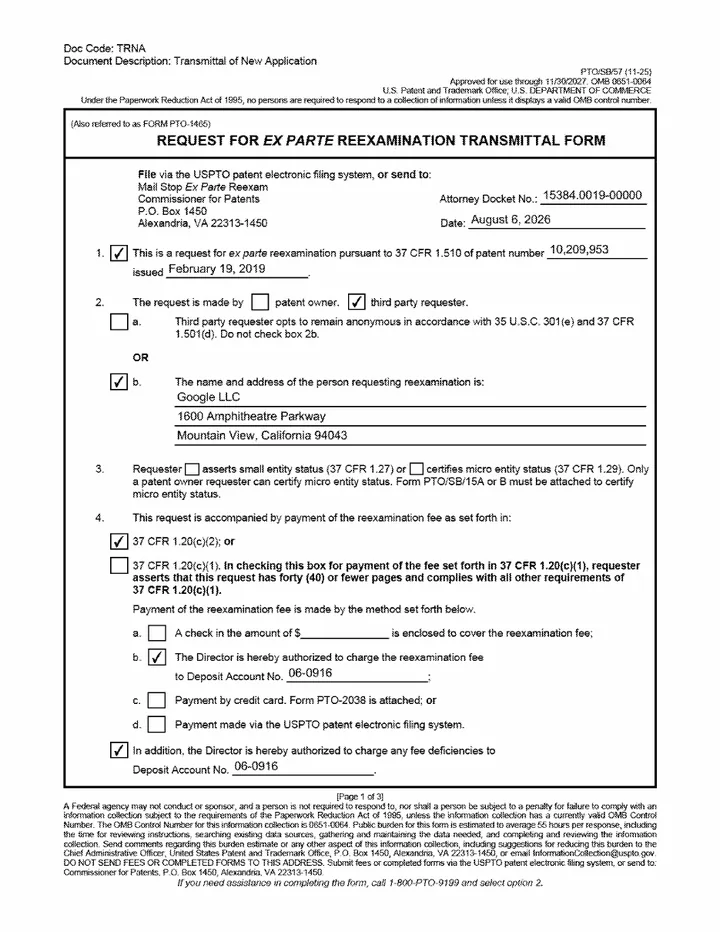
A real one, as filed
Request for ex parte reexamination of US 10,209,953, with transmittal form PTO/SB/57
Google's request against a Sonos patent on obviousness grounds. The Office ordered reexamination on 24 September 2026.
What it is
Request for ex parte reexamination, in brief
Ex parte reexamination asks the USPTO Central Reexamination Unit to reopen examination of an issued patent over prior patents and printed publications. The request sets out each substantial new question of patentability and applies the art to every claim for which reexamination is requested.
It is a prosecution comparison, not a short IPR petition: each question must be a new, non-cumulative teaching, or old art in a new light. The requester files one paper and at most one reply, and cannot appeal, attend interviews or withdraw the request.
Grounds it can carry
- Anticipation by a single prior patent or printed publication35 U.S.C. 102 via 302 and 1.552(a)
- Obviousness over one reference or a stated combination35 U.S.C. 103 via 302 and 1.552(a)
Use it when
- A patent or printed publication reads on the claims and you want them cancelled or narrowed.
- The 1-year IPR bar has passed, or the budget will not carry an IPR.
- You want no statutory estoppel, or the challenge should run through a practitioner for an undisclosed real party in interest.
Choose another route when
- You only want the art in the file, free and possibly fully anonymous. Citation of prior art in a patent file
- You are inside the IPR window and accept a trial with a higher threshold, discovery and estoppel. Inter partes review petition
- The attack needs 101, 112, public use, on-sale activity or conduct. Declaratory judgment complaint
How IPtorch builds it
From search to filing, minus the signature.
The invalidity search runs on into this filing when it ends, with no second click. Three model families take turns, so a draft is never checked by the model that wrote it.
- 1SearchClaims split into limitations, thousands of candidates screened, at least 50 references read in full.Gemini models read and check
- 2Claim mapA verbatim quotation and its location behind every limitation.Every cell checkable
- 3DraftWrites the papers in the office's format and language.Claude Opus 5.5 (Anthropic)
- 4ReviewChecks each citation against its document and builds the forms.Sol 6.1 (OpenAI)
- 5AdjudicateHigh strength: a third family rules on every objection.claude-fable-5-1[1m] (Anthropic)
- 6FolderUnsigned PDFs, ready for a professional to review, sign and file.Nothing is filed
What the builder does for this filing
- IPtorch frames each substantial new question against the art of record: what the reference teaches, what the examiner had, and why it is new and non-cumulative.
- It anchors the questions to the limitation that secured allowance and applies the art to every requested claim, limitation by limitation, with page, column and line pinpoints.
- It counts pages for the streamlined fee, where claim charts, arguing declarations and conclusions all count toward the 40-page limit.
- It refuses 101, 112, public use and conduct grounds, and drops any listed reference that no question or proposed rejection applies.
In the folder
- PTO/SB/57 transmittal dataField values for the request transmittal form
- Request for ex parte reexaminationEach substantial new question and proposed rejection under its own heading
- List of patents and publications relied onPTO/SB/08 equivalent, listing only references actually applied
- Appendix A: copy of the patentThe whole patent with every certificate and disclaimer
- Appendix C: copies of every cited documentWith labelled translations of the pertinent parts beside the originals
- Certificate of service and certificationsService on the owner and the requester certifications under 1.510(b)
- Fee sheet and page countStreamlined or full track, page count, deposit account authorisation
Builder strength
You choose how hard it is checked.
You pay for the tokens the sessions use, at the models' list prices plus a 30% fee, not for the time allowed. How pricing works
Low
- Opus 5.5 drafts the submission
- Sol 6.1 builds and checks the final forms
- Scripted checks of the package
- Fable 5.1 or Astra 6 finishes the package (final QA and fix)
- Checks after the final QA
Medium
- Opus 5.5 drafts the submission
- Sol 6.1 reviews and rebuilds the content
- Opus 5.5 builds the filing folder
- Sol 6.1 checks the form
- Scripted checks of the package
- Fable 5.1 or Astra 6 finishes the package (final QA and fix)
- Checks after the final QA
High
- Opus 5.5 drafts the submission
- Sol 6.1 runs a deep prior-art search
- Opus 5.5 rebuilds the submission against the evidence
- Sol 6.1 attacks it as an adversarial examiner
- Gemini 3.1 Pro adjudicates the objections
- Opus 5.5 applies the fixes and builds the filing folder
- Scripted checks of the filing folder
- Sol 6.1 audits the whole folder
- Convergence gate
- Fable 5.1 or Astra 6 finishes the package (final QA and fix)
- Checks after the final QA
What stays with you
You review, sign and file.
- Sign with your own S-signature and typed name, with registration number if you are a practitioner.
- Confirm the 315(e)(1) and 325(e)(1) estoppel position, and the anonymity affirmation where it applies.
- Serve the full copy on the patent owner and sign the certificate of service.
- Press Submit in Patent Center and pay the fee, or send the paper request by Priority Mail Express.
Where these go wrong
What the builder guards against.
- More than 40 counted pages on a streamlined fee with no authorisation to charge the difference: charts, arguing declarations and conclusions all count.
- Re-arguing art of record without a new light, or resting on KSR alone, raises no substantial new question.
Start with the evidence.
Upload the patent or enter its number. The invalidity search charts every claim, and the builder takes it from there.
Start an invalidity searchFacts checked against the office's rules on 22 September 2026, fees on 13 October 2026. The sample is a public record, reproduced unchanged. IPtorch is not a law firm and this page is not legal advice. Its output is unsigned work product for a registered professional to review, sign and file; nothing is filed and no fee is paid for you. Confirm current requirements, fees and deadlines with the receiving office.